 Analysis by Gamescozy
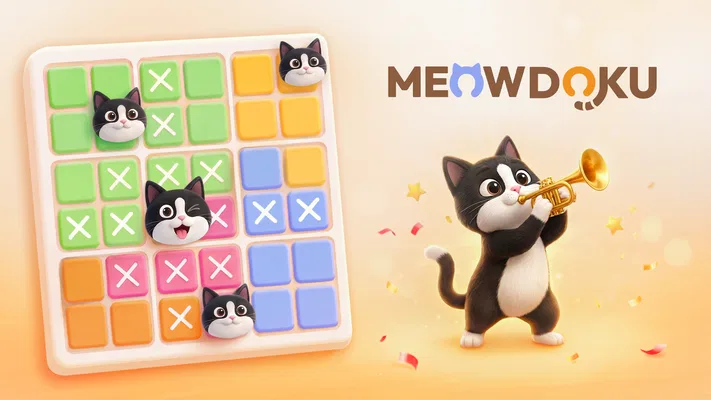
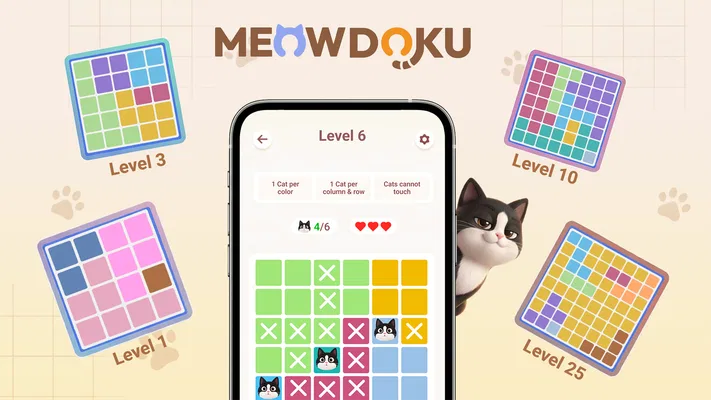
I like puzzle games that make me pause before tapping, and Meowdoku: Brain Puzzle Games has a neat premise: each move is about working out which squares belong to which cat. It brings together the deduction style of Sudoku and Minesweeper, but gives the logic a territorial goal. That makes a round feel less like filling a grid by routine and more like solving a small map. My main impression is that its appeal rests on the clarity of that central idea: careful observation matters more than quick reactions.
Small goals make the grid approachable
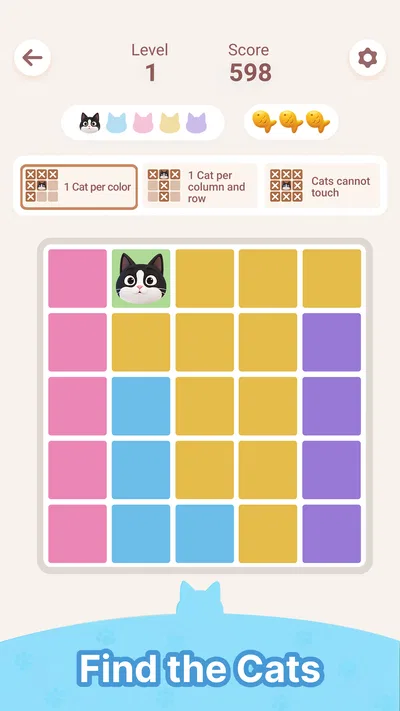
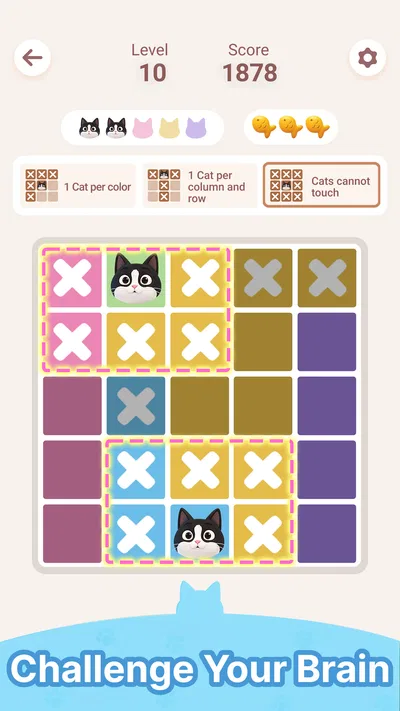
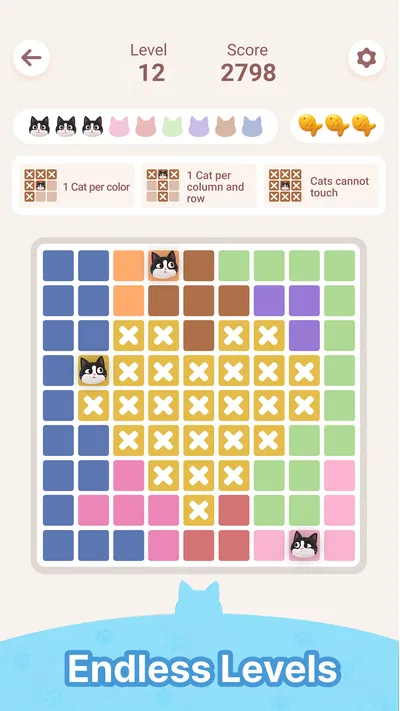
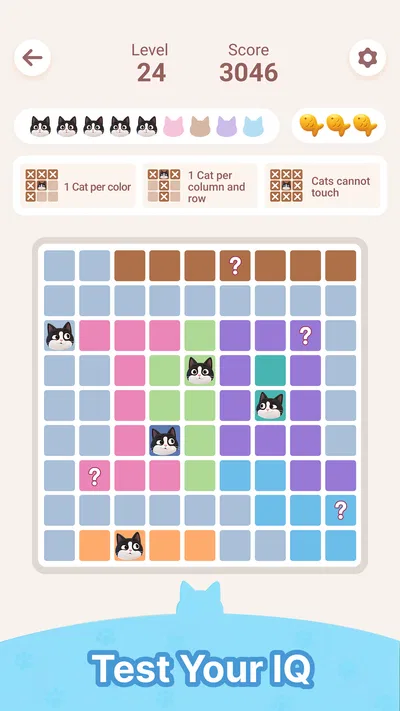
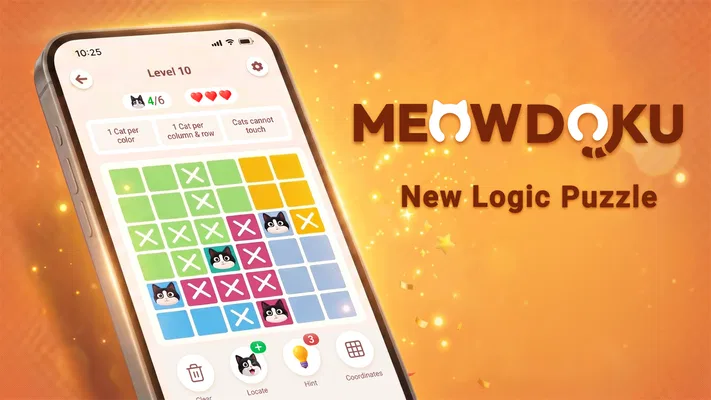
The game is a free puzzle title from Oakever Games, aimed at Everyone. Its central task is easy to understand, which helps when I want to start playing without a long tutorial or a complicated setup: examine the puzzle and use logic to identify every cat’s territory. The combination of familiar puzzle traditions gives newcomers a useful foothold while still leaving room to think.
What works for me is the way the objective turns a grid into a set of connected decisions. Sudoku players may recognize the satisfaction of narrowing down possibilities, while Minesweeper fans may enjoy reasoning from clues rather than guessing. Neither comparison tells the whole story, though: the cat-territory framing gives the deductions a specific purpose. Instead of merely asking which number or square fits, I’m trying to complete a coherent arrangement.
That makes the game a good fit for short, focused breaks. I can imagine opening it while waiting for a kettle to boil, then returning to a puzzle later if I have to stop. The logic-first format is also handy when I want something calmer than a fast arcade game. It asks for attention, but its basic premise does not demand a reflexes-heavy approach.
There is a trade-off: players who prefer a narrative, character collection, or a broad variety of puzzle mechanics may find the core loop narrow. The cats give the objective its identity, but this is still fundamentally a grid-deduction game. If I wanted a collection of unrelated brain teasers, I would look elsewhere. If I wanted one recognizable kind of reasoning to settle into, the focused design would be an advantage.
What counts as progress
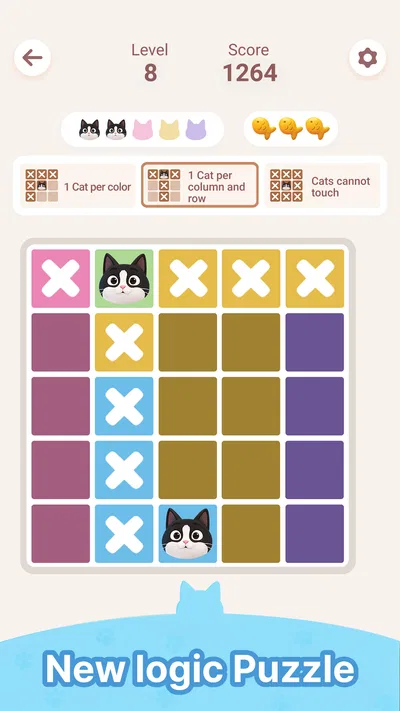
With a logic puzzle, progress is most satisfying when it comes from seeing a relationship that was easy to miss. The useful signal is not a flashy reward but a deduction that reduces uncertainty: one square constrains another, and the territory gradually becomes clearer. That makes the game’s goal feel concrete even when a board takes patience. I’m not simply waiting for a meter to fill; I’m trying to understand why a placement follows from the clues.
A practical way to approach a tricky grid is to separate what I know from what I suspect. I would first inspect the clearest constraints, then consider how each possible territory affects nearby squares, rather than committing to the first tempting pattern. If I get stuck, revisiting the assumptions behind a recent choice is more useful than tapping randomly. In a game built around Sudoku- and Minesweeper-like logic, disciplined elimination is a better habit than hoping a guess happens to work.
This style rewards an unhurried mindset. A useful everyday routine is to solve a few steps, pause when attention drops, and resume by checking the most certain parts of the board. That can prevent a small mistake from turning into a frustrating chain of confusion. It also makes the game easier to fit around interruptions: the puzzle remains a thinking task, not a race against a timer in my imagined use of it.
The limits of that progress model are worth keeping in mind. If someone needs frequent story revelations, elaborate unlocks, or a visible sense of character growth to stay motivated, pure deduction may feel austere. I would not assume that the game’s basic premise guarantees a constant stream of new mechanics. Its strongest reward is the satisfaction of resolving the board, so players should choose it for that kind of payoff rather than expecting a sprawling progression adventure.
Challenge depends on how you like to think
The blend of Sudoku and Minesweeper offers an appealing middle ground for people who enjoy logic but do not want to do arithmetic for its own sake. Sudoku players may appreciate constraint-based reasoning; Minesweeper players may recognize the need to infer safe or necessary squares from surrounding information. The difference is that the goal is framed around cat territories, so the task has a visual, spatial character as well as a logical one.
That combination can also expose a learning curve. Someone new to both inspirations may need time to understand which clues are decisive and how one conclusion affects the rest of the grid. The game’s short description is simple, but the underlying discipline is not the same as tapping wherever a square looks plausible. I’d recommend treating early play as practice in reading constraints, not as a test of speed.
For experienced puzzle fans, the format may be comfortable rather than startlingly novel. That is not necessarily a problem: a familiar logic vocabulary can make a new theme easy to approach. Still, anyone hoping for the unpredictability of word games, spatial rotation puzzles, or multi-step escape-room riddles may want a different option. Meowdoku’s identity is strongest when the player enjoys incremental deduction and wants the satisfaction of reaching a justified answer.
In a normal day, I’d use it when I have a few quiet minutes and enough focus to follow a chain of reasoning—during a commute while seated, in a waiting room, or after finishing a task and wanting a mental reset. I would skip it when I’m distracted, tired, or looking for something that can be played almost automatically. A logic puzzle can be relaxing, but only if I have the attention to engage with it; otherwise, the same carefulness can feel like work.
Steady engagement without assuming a reward treadmill
Any puzzle game has to balance challenge with the feeling that another round is worth starting. Here, the clearest reason to continue is the unfinished problem itself: I want to see whether my deductions will complete the cats’ territories. That is a more self-contained motivation than a story cliffhanger, and it suits players who enjoy reaching a clean solution. It may be less compelling for people who depend on frequent external rewards to keep playing.
I appreciate that the premise does not need a complicated explanation to invite another attempt. The puzzle’s objective is visible from the outset, so the immediate goal is easy to hold in mind. At the same time, simple goals can become repetitive if every board feels too similar. Whether the game sustains interest for a particular player will depend largely on how much they enjoy this specific style of grid logic, not on the theme alone.
There is also a sensible stopping point built into the activity: when I finish a board, I can leave with a complete result rather than needing to keep a real-time session going. That suits people who want a bounded break. Conversely, a player who wants a competitive loop, social play, or a rapidly changing set of activities should compare it with other puzzle options before settling in.
Meowdoku is free to download, with in-app purchases listed from $3.99 to $69.99 per item. I’d approach those purchases deliberately: the puzzle’s appeal should stand on whether I enjoy its core reasoning, rather than on a feeling that I must spend to make the basic idea worthwhile. The game has a 4.7 average from around 546,000 ratings, and it has passed 10 million installs. Those figures suggest a broad audience, but they do not tell me whether its particular logic style will suit an individual player.
Who should choose it—and who should pass
I’d recommend it to people who already like Sudoku, Minesweeper, or other deduction puzzles and want a fresh theme around a familiar kind of thinking. It is also a reasonable choice for someone seeking a free game with a clear central task and an Everyone age rating. The game is currently at version 1.22.0 and requires Android 7.0 or later, details worth checking against a device before downloading.
I would be more cautious if a player dislikes grids, gets annoyed when a puzzle requires sustained concentration, or wants every session to introduce a new mode. The combination of two familiar puzzle influences is a strength only if those influences sound enjoyable. If I wanted a looser, more playful experience, I’d choose a casual matching game; if I wanted richer variety, I’d look for a puzzle collection rather than a title centered on territory deduction.
My practical advice is to try it with a small amount of uninterrupted time and judge the moment-to-moment reasoning, not just the cat theme. Notice whether you enjoy eliminating possibilities and checking how one square changes the rest of the board. If that process feels rewarding, the simple goal can carry a satisfying session. If it feels like a chore, extra persistence is unlikely to change the basic nature of the game.
A focused puzzle with a clear reason to continue
For me, Meowdoku’s best quality is how directly its premise connects each decision to a larger goal. It gives logic fans a recognizable challenge while making the result feel like a territory being pieced together, rather than an abstract exercise. Its strongest sessions are likely to be the ones where I slow down, spot a constraint, and let that insight guide the next move.
Its focus is also its main limitation. This is not the choice I’d make for a story-driven game, a broad puzzle sampler, or a high-energy distraction. But for a calm break built around careful grid reasoning, it has a distinct hook and an easy-to-grasp objective. If you enjoy earning progress through deduction rather than speed or spectacle, this is the kind of puzzle worth trying.
Overall, I see it as a specific recommendation, not a universal one: a good fit for patient puzzle players who like the logic behind Sudoku and Minesweeper, and a weaker match for anyone seeking constant novelty. The cat-territory goal gives that familiar reasoning a personality, while the best reason to keep playing remains the simple pleasure of figuring out the board.